
Remanufacturing: Turning Circular Ambition into Industrial Opportunity

At the recent IMR Connect Day, manufacturers, industry leaders and technology experts explored a practical question: how can businesses recover more value from the products and equipment they already manufacture, use and maintain?
Through the panel discussion Circular Manufacturing in Practice: From Compliance to Competitive Advantage and an interactive workshop, participants explored how remanufacturing can help reduce costs, strengthen supply-chain resilience and create new business opportunities.
From rebuilding long-life industrial equipment to using robotics and digital technologies to recover components, the discussions evidenced that remanufacturing is more than a circular economy ambition. It is an opportunity to improve manufacturing competitiveness, provided businesses can overcome challenges around technology, quality assurance, market demand and regulation.
Key Takeaways
For industry
Remanufacturing turns circularity into competitive advantage. By recovering value from existing products and equipment, manufacturers can reduce waste and resource consumption while creating new revenue streams, lowering costs and strengthening supply-chain resilience.
Turning circular ambition into industrial practice requires an integrated approach. Combining circular economy expertise with advanced manufacturing, robotics, digital technologies and viable business models can help manufacturers overcome technical and commercial barriers and scale remanufacturing.
For policymakers
EU legislation is increasingly recognising remanufacturing, but regulatory fragmentation remains a challenge. Definitions of remanufacturing differ across legislation, reflecting different regulatory objectives and product characteristics. This fragmentation can create uncertainty for businesses, particularly those operating across sectors. Greater consistency in definitions and clearer rules around the waste status of products and components could help remove barriers to adoption.
Scaling remanufacturing in Ireland requires targeted policy support. Better access to product information, skills development, stronger supply-chain collaboration and measures such as green public procurement can help overcome barriers and support wider adoption.
From circular ambition to commercial opportunity
The panel, chaired by Dr Geraldine Brennan, Director of Circular Economy Innovation at IMR, brought together perspectives from across the product lifecycle, including original equipment manufacturing, product recovery, circular business models and advanced technologies.
Joe Coleman from Combilift highlighted the potential to recover value from long-life industrial equipment. With machines designed to operate for 20–25 years, significant value remains in their structures and components. Rebuilding existing equipment to a like-new standard could create new commercial opportunities, offer customers more affordable alternatives and help manufacturers reach additional markets.
Mark O'Sullivan from iQuTech drew on experience in the electronics sector, where product recovery and remanufacturing have long been commercially driven. His contribution highlighted the importance of spare-parts availability, efficient reverse logistics and recovering value from returned products. It demonstrated that remanufacturing is not necessarily a new business concept, even if its contribution to circularity is receiving greater attention today.
From the automotive sector, Richard Brennan of Evolve illustrated how circular business models can connect different actors across the value chain. Facilitating the use of reclaimed and remanufactured vehicle parts can offer alternatives to new components while delivering economic and environmental benefits. His example highlighted the importance of connecting suppliers, insurers, repairers and customers to create demand.
Technology was another important part of the discussion. Dr Aswin Ramasubramanian from IMR presented the EU-funded REWIRE project, which explores how robotics, automation and digital technologies can support remanufacturing. Through industrial use cases, the project is investigating how digital traceability, automated inspection, disassembly and testing can make remanufacturing more efficient, reliable and scalable.
Together, these examples demonstrated the diversity of remanufacturing opportunities across industries and product lifecycles.
A recurring theme was trust and quality assurance. For remanufacturing to compete with new production, customers need confidence in product performance and reliability. Robust testing, traceability, warranties and consistent quality standards are therefore essential.
Exploring opportunities through the workshop
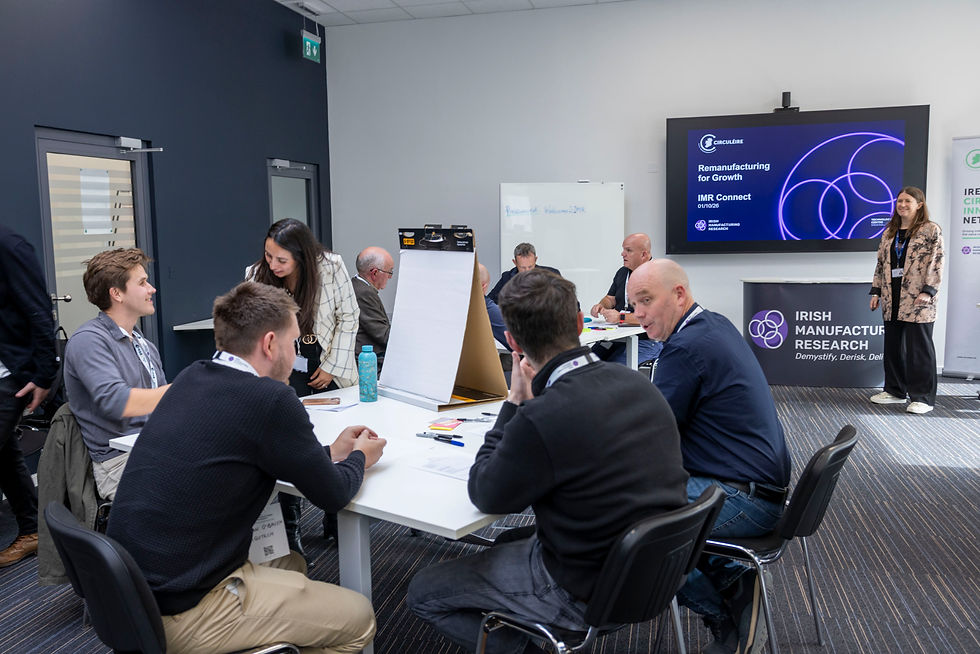
Building on the panel discussion, a group of attendees took part in an interactive workshop to consider how remanufacturing could apply to their organisations.
Participants identified opportunities including cost savings, supply-chain simplification, extending equipment lifetimes and recovering valuable components. However, recurring barriers included limited access to technical information, difficulties demonstrating product performance, regulatory uncertainty and skills gaps.
The discussions highlighted a consistent message: remanufacturing opportunities need to be assessed through both a technical and commercial lens. Identifying products with recovery potential is only the starting point. Manufacturers also need to consider access to components and product information, the processes required to restore performance, customer confidence and whether the business case supports implementation.
Addressing these challenges requires a combination of manufacturing expertise, enabling technologies, collaboration and appropriate policy support.
Remanufacturing: A significant economic opportunity
Remanufacturing restores products or components to a specified, like-new level of performance through an industrial process involving activities such as inspection, disassembly, component replacement, reassembly and testing.
Unlike recycling, which recovers materials, remanufacturing preserves more of the value already embedded in products, including their components, engineering and manufacturing effort. Its economic potential is significant.
A 2015 European Remanufacturing Network Market Study estimated that Europe's remanufacturing industry generated approximately €30 billion in annual turnover and employed around 190,000 people at the time. It also projected potential growth to approximately €90 billion by 2030, subject to supportive policies and investment.
These figures illustrate the scale of the opportunity. For manufacturers, remanufacturing can create revenue streams, extend customer relationships, reduce dependence on virgin materials and strengthen supply-chain resilience.
Building the evidence base for remanufacturing in Ireland
In 2024, CIRCULÉIRE (Ireland's Circular Innovation Network), designed and led by IMR, published its Remanufacturing Thematic Working Group Insights Report. Drawing on industry workshops and policy discussions, the report explored the opportunities, challenges and enabling conditions for remanufacturing in Ireland, identifying priorities for industry and policymakers.
More recently, the EPA-funded Research Report 520: Remanufacturing for Ireland (ReManIre), published in September 2026 and led by the University of Limerick, examined how remanufacturing could be scaled nationally. Based on research and stakeholder engagement, it proposed a more coordinated approach, including a national roadmap, policy framework and Centre of Excellence for remanufacturing.
The 2026 EPA-funded research report echoes several conclusions from CIRCULÉIRE's earlier work in 2024, particularly the opportunities for industrial competitiveness and resource efficiency, alongside persistent barriers relating to regulatory clarity, access to products and information, skills and market development.
Together, these reports reinforce the importance of creating the right policy, technical and commercial conditions to enable remanufacturing to scale across Irish industry. Measures such as green public procurement could help stimulate demand for remanufactured products, while improved access to product information, investment in skills and stronger supply-chain collaboration could help manufacturers overcome practical barriers to adoption.
An evolving policy landscape: Growing recognition, but remaining barriers
Remanufacturing is receiving increasing recognition in European product legislation, reflecting its potential to extend product lifetimes, retain valuable resources and support industrial competitiveness.
The Ecodesign for Sustainable Products Regulation (ESPR), for example, explicitly defines remanufacturing and identifies it as a relevant consideration for future ecodesign requirements. Its Digital Product Passport framework could also improve access to product information, supporting activities such as disassembly, component identification and recovery.
Similarly, the EU Batteries Regulation establishes specific provisions for battery remanufacturing, recognising its role in extending battery lifetimes. The revised Construction Products Regulation also recognises remanufactured products, while the proposed End-of-Life Vehicles Regulation reflects growing attention to circularity and the recovery of value from vehicle components.
These developments represent important progress. However, greater recognition has not yet translated into a harmonised regulatory framework. Definitions of remanufacturing differ across legislation, reflecting different regulatory objectives and product characteristics. This fragmentation can create uncertainty for businesses, particularly those operating across sectors.
Another challenge concerns the relationship between remanufacturing and waste legislation. As highlighted in CIRCULÉIRE's 2024 report, uncertainty around when products or components are legally considered waste can create significant regulatory and operational barriers.
The Batteries Regulation offers an interesting example of how this distinction can be approached. It recognises that remanufacturing can involve both used batteries and waste batteries. For waste batteries, remanufacturing may constitute preparation for re-use or preparation for repurposing, while remanufacturing of used batteries is described as an intensive form of re-use.
This illustrates an important principle: remanufacturing does not inherently determine whether an input is waste or non-waste. The legal status of the product entering the process and the nature of the remanufacturing activity should be considered separately, with the relevant requirements applying accordingly.
Although sector-specific, this approach provides a useful reference for future policy discussions.
As remanufacturing becomes more prominent within EU circular economy and industrial policy, greater consistency in definitions, clearer guidance on waste status and supportive regulatory frameworks will be instrumental.
For Ireland, translating growing policy recognition into practical opportunities will require the clarity and conditions that enable manufacturers to invest, innovate and develop commercially viable remanufacturing activities.
From opportunity to implementation: IMR's role in advancing remanufacturing
The discussions at IMR Connect highlighted that scaling remanufacturing requires more than recognising its potential. Manufacturers need practical solutions to overcome technical challenges, develop viable business models and navigate an evolving regulatory landscape.
At Irish Manufacturing Research (IMR), we bring together expertise in advanced manufacturing, robotics, automation, digitalisation and circular economy innovation to help manufacturers explore these opportunities.
From developing technologies for inspection, disassembly and component recovery to improving product traceability and lifecycle information, IMR's research capabilities can support the development of more efficient and reliable remanufacturing processes.
Through CIRCULÉIRE, designed and led by IMR, we help bridge the gap between circular economy ambition and industrial implementation, combining technology, research, business model innovation and policy insights to support practical solutions for Irish manufacturers.
Remanufacturing offers significant opportunities for Irish industry. Realising them will require continued collaboration between manufacturers, technology providers, researchers and policymakers.
Interested in exploring remanufacturing opportunities within your organisation? Connect with IMR to discuss how our expertise and collaborative innovation activities can support your next steps through national networks like CIRCULEIRE or engagement with EU projects like REWIRE.


Comments