
CIRCULÉIRE NON-MEMBER CASE STUDY
COMPANY: MiALGAE
WEBSITE: MIALGAE.COM
SECTOR: BIOTECHNOLOGY, AQUACULTURE & AGRI-FOOD
PUBLISHED: 15th JULY 2026
TAGS: CIRCULAR BIOECONOMY, DISTILLERY WASTE, FERMENTATION, BY-PRODUCT VALORISATION, MICROALGAE, AQUACULTURE, FISHMEAL REPLACEMENT, JUST TRANSITION
The Challenge
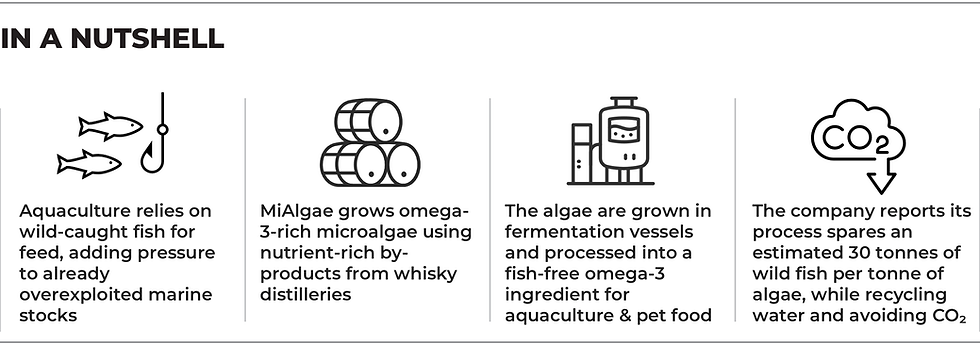
Global fish stocks are under sustained pressure: as of the most recent FAO assessment, 35.5% of the world's marine fish stocks are classified as overfished (FAO, 2025). A significant share of this pressure comes from "reduction fisheries" - fishing aimed not at direct human consumption but at producing fishmeal and fish oil - which land an average of 23.4 million tonnes of forage fish a year, around a quarter of all wild marine catch by volume (Majluf et al., 2024).
Having fallen well below its 1990s peak, the volume of wild fish reduced to fishmeal and fish oil is now projected to rise again over the coming decade, according to the OECD-FAO's latest joint outlook, which identifies the EU as one of the two largest global consumers of fish oil - expected to account for 15% of world demand by 2034 (OECD/FAO, 2025). Ireland has a direct stake in this: marine ingredients still made up around 62% of feed for its organic farmed salmon at the sector's 2017–2019 baseline, including 18% fish oil (Cooney et al., BIM, 2025).
A Circular Solution
MiAlgae produces omega-3-rich microalgae by recycling nutrient-rich by-products from whisky distilleries, including Falkirk Distillery (Scotch Whisky Association, n.d.). In Scotland, approximately 15 litres of co-product are generated for every litre of whisky produced (Zero Waste Scotland, 2026). MiAlgae uses them as a feedstock for fermentation in 30,000-litre bioreactors, which the company states are run on renewable energy (Just Transition Commission, 2025). Throughout the process, growth is monitored to maintain oil quality (University of Edinburgh, n.d.). The dried algae is sold as a microalgal omega-3 ingredient for the aquaculture and pet food sectors, giving distilleries a lower-cost, lower-impact route for co-products that would otherwise require disposal (University of Edinburgh, n.d.).
The company's production model is designed to be modular, replicable and scalable, enabling facilities to be located close to whisky distilleries to minimise transport requirements and simplify feedstock collection. Construction of the new Grangemouth facility began in December 2025, with commercial production scheduled to commence in spring 2026 (Zero Waste Scotland, 2026).
Environmental, Social and Economic Impact
Over a recent six-month period, MiAlgae reports that it recycled wastewater equivalent to nearly 300 Olympic-sized swimming pools and prevented 150,000 kg of CO₂ emissions - comparable to eliminating 500 round-trip flights between London and Edinburgh (Just Transition Commission, 2025). For every tonne of algae it produces, the company saves an estimated 30 tonnes of fish that would otherwise be caught for fishmeal and fish oil (Scottish Government, 2025). Zero Waste Scotland estimates that, scaled across further sites near Scotland's whisky distilleries, the model could average 100,000 tonnes of CO₂ saved per site annually (Zero Waste Scotland, 2024).
MiAlgae's Grangemouth facility is backed by £3 million in joint UK and Scottish Government funding and is the first new project at the Grangemouth site since its oil refinery closure (UK Government, 2025; Scottish Government, 2025). Over the next five years, the project is expected to create around 310 jobs - roughly 130 directly at the Grangemouth site and a further 180 supported elsewhere in Scotland - and deliver an estimated £53 million into the Scottish economy (UK Government, 2025; Scottish Government, 2025). As a condition of the public funding, eligible local workers are given priority during recruitment, and the facility is expected to help move workers into biotech from Scotland's oil and gas sector as part of Scotland's just transition (UK Government, 2025; Just Transition Commission, 2025).
Replicability
The model addresses a growing need for sustainable omega-3. Fish oil remains the only economically viable source of the long-chain omega-3s that farmed fish require, which makes it a limiting factor for the sector's growth. Demand is set to intensify: global aquaculture output overtook wild capture fisheries in 2023, reaching 97.6 million tonnes, and is projected to reach 112 million tonnes by 2033 - growth that will widen a gap fish oil alone cannot fill (European Commission & EUMOFA, 2025). Aquaculture's share of global fishmeal use, which rose from 63% in 2009 to 92% in 2023, underlines how heavily the sector already leans on marine ingredients (European Commission & EUMOFA, 2025).
MiAlgae's own model is built to be replicated - a modular design intended to be rolled out close to distilleries across Scotland - and it sits within a growing ecosystem of related approaches to sustainable feed:
INNOAQUA (EU) - a €7.2 million Horizon Europe project cultivating microalgae on aquaculture wastewater to produce omega-3-rich, protein-rich ingredients under the Farm-to-Fork Strategy.
Horizon Proteins (United Kingdom) - a Heriot-Watt University spin-out that shares MiAlgae's whisky-by-product feedstock, extracting protein from pot ale for Scottish salmon feed.
Ocean Harvest Technology (Ireland) - produces seaweed-derived feed ingredients for aquaculture and livestock, developed through an Enterprise Ireland Innovation Partnership.
Veramaris (Netherlands) - produces the omega-3 fatty acids EPA and DHA directly from marine algae as an alternative to fish oil.