
CIRCULÉIRE NON-MEMBER CASE STUDY
COMPANY: RE-TURN
WEBSITE: RE-TURN.IE
SECTOR: PACKAGING
PUBLISHED: 31st JULY 2026
TAGS: DEPOSIT RETURN SCHEME, PACKAGING, PLASTIC RECYCLING, CIRCULAR MANUFACTURING, CLOSED-LOOP RECYCLING, MATERIAL PURITY, EXTENDED PRODUCER RESPONSIBILITY, LITTER REDUCTION, POLICY-DRIVEN CIRCULARITY, CONSUMER BEHAVIOUR CHANGE
The Challenge
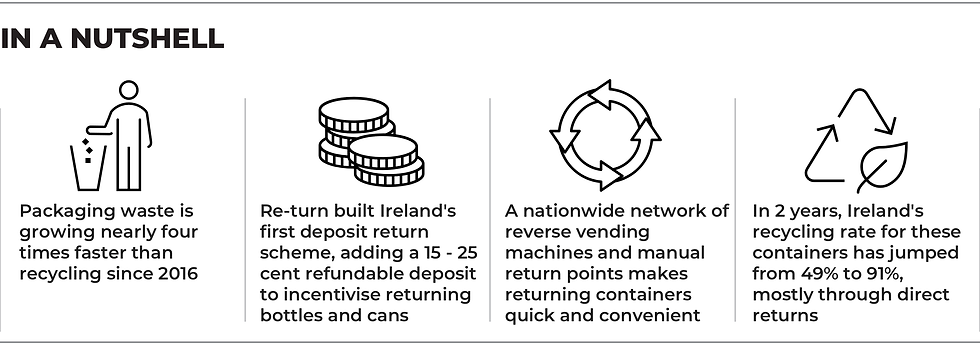
Packaging waste in Ireland has grown by almost 20% since 2016, while recycling of that same packaging has grown by only 5% over the same period, meaning waste is piling up nearly four times faster than the ability to recycle it, and the recycling rate is falling as a result (EPA, 2025).
Plastic packaging recycling stood at just 30% in 2023, missing the EU's 2025 target of 50% (EPA, 2025). Metal fares little better: ferrous recycling has dropped below target, and aluminium, though improving, remains below target too (EPA, 2025). For plastic bottles, aluminium and steel cans combined, only 49% were being recycled as of 2022, despite all three materials being straightforward to recycle once collected (Re-turn, 2025).
Bottles and cans face an added layer of EU regulation on top of general packaging rules. The Single-Use Plastics Directive, transposed into Irish law in 2021 (DCEE, 2021), requires 77% of single-use plastic beverage bottles up to three litres, including caps and lids to be separately collected by 2025, rising to 90% by 2029 (The European Parliament and The Council, 2019) . A newer EU Regulation, the PPWR, applies automatically across all member states from August 2026 and extends this same 90% separate collection target to metal beverage cans as well (The European Parliament and The Council, 2025).
A Circular Solution
Re-turn's approach is built on Extended Producer Responsibility (EPR), an environmental policy that shifts the cost of a product's end-of-life, take-back, recycling, disposal, from government and consumers onto the producers who place it on the market. Re-turn is the independent, not-for-profit company appointed by the Irish Government to deliver this through the national Deposit Return Scheme (DRS), live since 1 February 2024 (Re-turn, 2025).
Producers placing PET bottles or aluminium and steel cans, 150 ml to 3 litres, on the Irish market must register and pay a fee per product. Containers bearing the Re-turn logo carry a refundable deposit, €0.15 up to 500 ml, €0.25 above, added to the price the customer pays (Re-turn, 2025). The customer gets this deposit back by returning the empty, undamaged container to any registered return point nationwide - reverse vending machine or manual take-back - regardless of where it was purchased.
Re-turn has partnered with Limerick Polymers Production (LPP) to handle the scheme's logistics. LPP collects and sorts returned containers from shops and reverse vending machines and manual return points, then transfers the sorted, baled material to third-party buyers. These materials are sold on to reprocessors in Ireland, the UK and Europe, feeding new containers and this sale forms one of Re-turn's own operating income streams (Re-turn, 2025). Because containers are separated at the point of return, the scheme consistently produces bales exceeding 99% purity - beyond the 95% food-grade threshold set by the European Food Safety Authority - enabling genuine bottle-to-bottle and can-to-can recycling, currently via export while a domestic food-grade facility is being developed.
Environmental, Social and Economic Impact
In its two years of operation, the scheme has facilitated the collection of 2.5 billion drinks containers (Re-turn, 2026). The recycling rate for in-scope containers has risen from 49% to an estimated over 91%, with 76% captured directly through the scheme and the remainder via mixed dry recycling (Re-turn, 2025). Irish Business Against Litter's latest survey found cans and plastic bottles are now 60% less common nationwide than when the scheme launched (Re-turn, 2026). Aluminium recycling in particular carries an outsized benefit: it saves 95% of the energy and 97% of the emissions of primary aluminium production (International Aluminium, n.d). Ballygowan, Britvic Ireland's Natural Mineral Water brand, has trialled Ireland's first "circular bottle", made using recycled PET sourced entirely through Ireland's own Deposit Return Scheme (Britvic Ireland, 2026).
The scheme's social impact has scaled alongside its environmental one. More than 4,600 schools, clubs and community groups have used it to fundraise locally, and the Return for Children initiative, supporting six children's charities has raised over €410,000 since June 2024, including €300,000 in 2025 alone (Re-turn, 2026).
Financially, Re-turn is not-for-profit and not government-funded, drawing income from three sources: producer fees and material sales, and unredeemed deposits (€66.7m, a figure expected to shrink as return rates climb). The fees from unredeemed deposits were reinvested into scheme infrastructure, expansion of Reverse Vending Machines (RVMs), consumer education campaign, etc (Re-turn, 2025).
Replicability
Ireland's scheme is not an outlier. Deposit return is a proven, high-performing model across Europe, with established systems consistently achieving return rates around or above 90%:
Deutsche Pfandsystem GmbH (Germany), a deposit return scheme operating since 2003, covers single-use PET, metal cans (aluminium and tinplate) and glass beverage containers, consistently achieving a return rate of approximately 98% among the highest in the world (TOMRA, 2026).
Infinitum (Norway) operates a return-to-retail, producer-funded deposit return scheme. Norway's tradition of returnable containers dates back to 1902, though Infinitum's current single-use system was established in 1999. In 2024, it achieved a 93% return rate and a total collection rate of 98% across cans (aluminium and tinplate) and plastic bottles (PET and HDPE) (TOMRA, 2024).
Užstato Sistemos Administratorius (USAD) (Lithuania), a deposit return system introduced in 2016, raised its PET bottle return rate from 34% to approximately 91.9% within two years of launch, reaching 90% overall by the end of 2025 (TOMRA, 2026).
Palpa(Finland), a deposit return scheme, achieves return rates of around 90% for PET bottles, 99% for aluminium cans, and 98% for glass bottles.